
mystery literature
Hóu Dàlì's Criminal Investigation Case Notes

Rate This Book
About The Series
🍿 FORMAT
Book (📕)
📕 TITLE OF BOOK OR SERIES
Hóu Dàlì's Criminal Investigation Case Notes
🎭 ALTERNATIVE TITLE
侯大利刑侦笔记
🌎 COUNTRY OF ORIGIN
China (Mainland)
🧑🏻🦰 AUTHOR
Xiaoqiao Laoshu (小桥老树)
🕵️ DETECTIVE(S)
Hou Dali
✅ SERIES STATUS
Completed
#️⃣ VOLUME(S)
9 Volumes. Generally sold as an anthology rather than individually.
🗓️ PUBLISHED
The first volume was published March 1, 2020 with the following eight volumes published between then and 2023.
🔄 ENGLISH TRANSLATION
Chinese
Content Rating
⌛ ESTIMATED AGE LEVEL
Ages 18+ (Adult)
⚔️ VIOLENCE
Strong
🫣 FOUL LANGUAGE
Mild
💋 SEXUAL CONTENT
Mild
💯 OVERALL ASSESSMENT
Adult Audience
Content ratings and notes provided on this site reflect personal observations and opinions only. They are not intended to be relied upon as the sole source of guidance when deciding whether a novel or other literary work is appropriate for children, sensitive viewers, or vulnerable adults. Always consult multiple reviews, official content advisories, and parental guidance resources before viewing.
Synopsis
Genres & Themes
Plot & Book Blurb
百万作家小桥老树全新悬疑巨作
百万畅销书《侯卫东官场笔记》作者小桥老树,2020年全新悬疑巨作。一部集侦查学、痕迹学、社会学、尸体解剖学、犯罪心理学之大成的教科书式破案小说。小桥老树:警察世家出身,曾在政法系统工作近十年,见证了无数个真实犯罪案例。39桩大案要案、68个犯罪现场、107种侦查手段、614位涉案人员,还原每一起罪犯从调查、取证、抓捕到侦破的全过程。不夸张,展现真实犯罪;不血腥,却看得人汗毛直竖。精读刑侦文献上万册,解析中外案例370多个,走访一线警察83人,又翻烂了父兄的十几本工作笔记,终于写成这部超还原、超写实的破案小说。16年为爱追凶,几次直面生死,侯大利把大脑磨炼成电脑,把眼睛淬炼成显微镜,逐一锁定案发现场和尸检中的关键信息。凭借变态级的观察力,他往往透过庞杂的社会关系,率先圈定凶手的行为特征和成长环境,将其缉拿归案。怀着命案必破的信念,侯大利从一个菜鸟迅速成长为行走的刑侦教科书。翻开本书,带您见识教科书式的破案手法和刑侦智慧!(Source)
A brand new masterpiece of suspense by best-selling author Xiǎoqiáo Lǎoshù (小桥老树).
From Xiǎoqiáo Lǎoshù, author of Hóu Wèidōng’s Official Notes (侯卫东官场笔记) which sold more than a million copies, comes an all-new suspense novel published in 2020. A textbook-quality procedural crime novel that brings together the finest achievements of criminal investigation, forensic science, sociology, forensic anatomy, and criminal psychology. Born into a family with a long line of police officers, Xiǎoqiáo Lǎoshù spent nearly a decade working within China’s law enforcement and judicial system, where he gained firsthand experience with countless real criminal cases.
Drawing on 39 major criminal cases, 68 crime scenes, 107 investigative techniques, and 614 individuals connected to the cases, the novel faithfully reconstructs every stage of a criminal investigation—from the initial investigation and evidence collection through to the final arrest and case resolution. Not sensationalized, yet it portrays crime as it truly is; not gratuitously graphic, yet realistic enough to make one’s hair stand on end.
To write this novel, Xiǎoqiáo Lǎoshù immersed himself in more than 10,000 volumes of criminal investigation literature, analyzed over 370 Chinese and international criminal cases, interviewed 83 frontline police officers, and thoroughly wore out more than a dozen work notebooks belonging to his father and older brother. The result is a highly authentic, meticulously realistic, and deeply immersive criminal investigation novel.
For sixteen years, driven by the loss of someone he loved and his pursuit of the murderer, Hóu Dàlì has repeatedly stared death in the face. He has honed his mind into a computer and his eyes into microscopes, enabling him to methodically pinpoint the crucial clues hidden within crime scenes and autopsy reports. With an almost superhuman power of observation, Hóu Dàlì cuts through even the most tangled social networks to identify a killer’s behavioral patterns and upbringing, ultimately bringing them to justice. Driven by the firm belief that no homicide should ever go unsolved, Hóu Dàlì has grown from a rookie investigator into a walking textbook of criminal investigation. Open this book and experience textbook-level investigative methods and criminal investigative insight!
Works In The Series

Hóu Dàlì’s Criminal Investigation Case Notes
(侯大利刑侦笔记)
#️⃣ Volume: 1

Identifying Bones to Find the Killer
(辨骨寻凶)
#️⃣ Volume: 2

The Cloud of Forensic Evidence
(鉴证风云)
#️⃣ Volume: 3
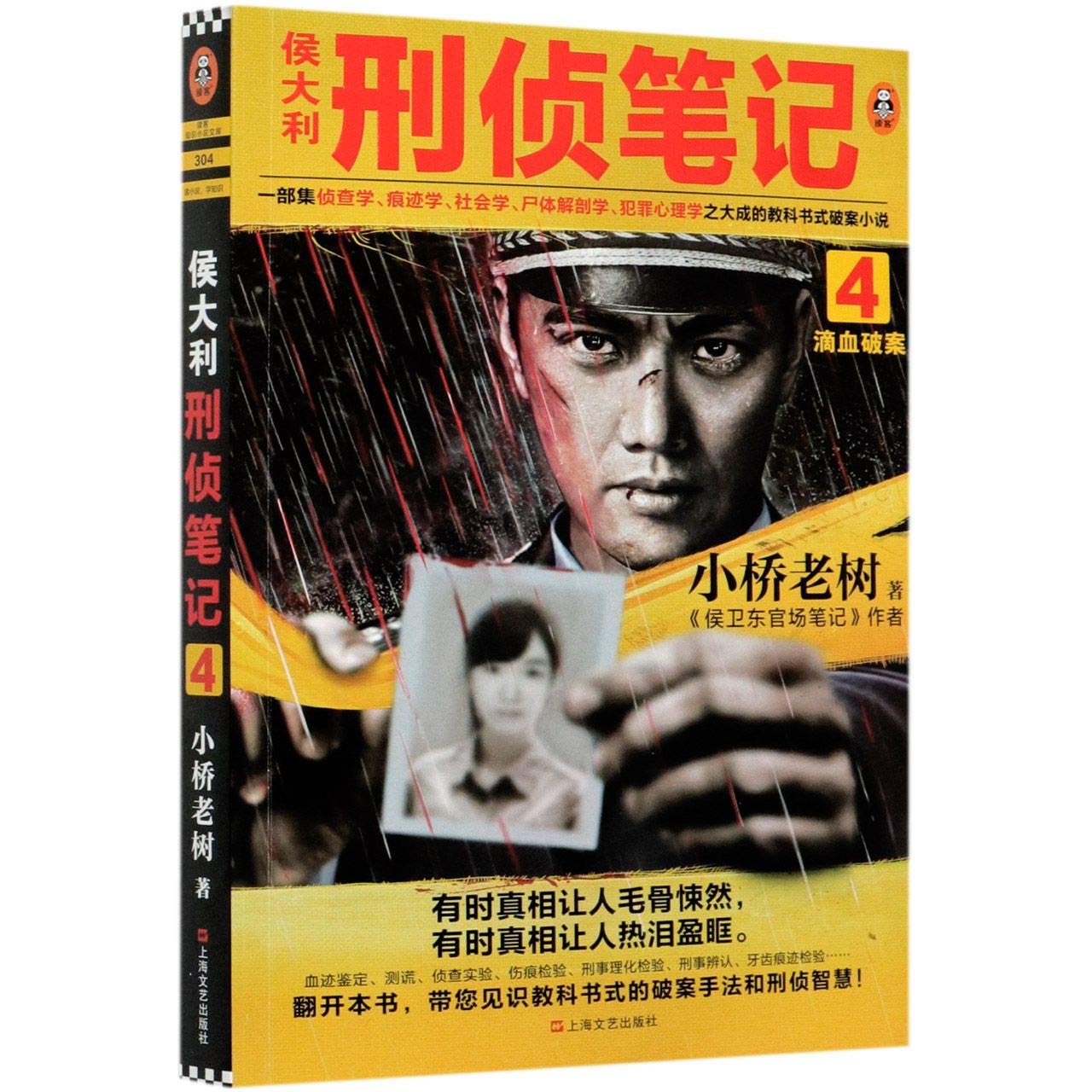
Solving Cases With a Drop of Blood
(滴血破案)
#️⃣ Volume: 4

Toxicology to Hunt the Killer
(验毒缉凶)
#️⃣ Volume: 5

Tracking the Killer Through Surveillance
(天眼追凶)
#️⃣ Volume: 6

Joint Case Investigations
(并案侦破)
#️⃣ Volume: 7

Tracing Cold Cases
(旧案寻踪)
#️⃣ Volume: 8

The Final Case
(大结局)
#️⃣ Volume: 9
This post may use Affiliate Links. Any earned commissions come from the seller at no additional cost to you. 💗 These commissions generally go towards supporting Never Quit Looking, our database for missing persons, unidentified persons, and unsolved homicides.
Pronunciation of Hóu Dàlì (侯大利)
Chinese names are traditionally written in the reverse order of most English-language conventions, with the surname name first and the given name second.
Hóu (侯) is the surname in this case and is pronounced closely to “h + long o“, with a soft, open vowel sound similar to the “ho” in hope. His given name is Dàlì or Dà Lì (大利), pronounced as “dah + lee“. The name carries an auspicious meaning, often translated as “great success” or “great prosperity,” reflecting his parents’ hopes that he would grow into a capable, successful, and fortunate individual. He clearly lives up to their aspirations as an exceptionally skilled and accomplished police investigator.
About the Author

Xiǎoqiáo Lǎoshù (小桥老树) is the pen name of Zhang Bing (张兵), a bestselling Chinese novelist and Vice Chairman of the Chongqing Writers Association. He was raised in a family with a long tradition of police and legal work, and later spent many years himself working within China’s political-legal system. These experiences give his fiction a strong grounding in institutional processes, investigative procedure, and bureaucratic realism.
Before turning to crime fiction, he achieved major commercial success with political and institutional dramas, most notably the bestselling series “Hóu Wèidōng’s Official Notes” (侯卫东官场笔记) and “The Grassroots Chronicles of Hóu Hǎiyáng” (侯海洋基层风云). These works are widely known for their detailed depiction of local governance, career progression within the Chinese administrative system, and the intersection between personal ambition and institutional structure.
In his later shift toward crime fiction, Xiaoqiao Laoshu brought the same documentary-style realism into criminal investigation narratives. His writing is characterized by:
- Heavy emphasis on procedural accuracy
- Close attention to investigative detail and evidence logic
- Semi-Documentary tone that blends real-case inspiration with fictional reconstruction
As a result, his crime novels often feel less like sensational mysteries and more like case files rendered into narrative form, focusing on how investigations actually unfold within real institutional constraints.
Table of Contents
Note: My unofficial translation was created as a personal language-learning project and to introduce English-speaking readers to fascinating Chinese mystery fiction that to my knowledge is not currently available in English in the United States. It is shared for noncommercial purposes only, and no copyright infringement is intended.
All rights to the original work remain with the author and publisher. If you are the copyright holder or an authorized representative and would like this translation removed, please contact me at thesuitcasedetective@outlook.com, and I will promptly comply.
Join The Conversation!
The Suitcase Detective is a growing global archive of mystery and investigation content, including true crime case files, detective literature, films, television series, and radio and podcast storytelling. Follow us as we document, preserve, and connect the stories behind the mysteries.
Notes
为爱追凶 (lit. “for love pursues the murderer”): The phrase suggests that Hóu Dàlì is driven by the death of someone he loved, and that avenging or solving their murder is the motivation behind his actions. ↩
Note: In Mandarin pinyin, “ao” is a smooth vowel glide rather than a strict “ah + oh” combination, and is often approximated in English as “ow” (as in cow). The name Xiǎoqiáo Lǎoshù (小桥老树) is therefore commonly pronounced approximately as Shyow Chyow Laow Shoo. ↩