
Ben Needham
Ben Needham was a two year old boy who vanished in 1991 from his grandmother's home in Kos (Κως), one of the Greek Dodecanese islands. Please contact police, your nearest embassy, or other appropriate officials if you have information that may help in resolving this case.

Details
🧑Identity
Full Name: Ben Needham
Alternative Name: Little Ben
Case Status: Missing
Record ID#: 0318
*The names “Jane Doe” and “John Doe” are English names used when the person’s true name is not known. If used above, the name refers to a person of unknown identity.
🪪 Description
Date of Birth*: October 29, 1989
Birthplace: Boston, Lincolnshire, England
Age at the Time: 1 (21 Months)
Age Group: Infant
Biological Sex: Male
Hair: Short, find Blonde or Lightly Colored baby soft hair. Some say it was a sandy blonde or fair like his mother’s.
Eyes: Generally described as Blue but sometimes with Hazel thrown in (his pictures fluctuate between blue and hazel appearing as well).
Skin Complexion: Fair or Light
Shoe Size:
Ethnicity: Caucasian or White
Nationality: Britain, United Kingdom
Languages Spoken: English
*If the date says January 1, this is often just a placeholder for an unknown specific date. It usually means “sometime that year”.
💪Physical Build
Physical Build:
Height:
Feet and Inches (ft’ in”)
Centimeters (cm)
Weight
Pounds (lbs)
Kilograms (kg)
👁️ Distinguishing Features
Distinguishing Marks:
- Birthmark
Medical Condition:
Physical Abnormality:
Dental Condition:
Scars & Other Marks: Ben had two very distinctive birthmarks that could help identify him. (1) The first was a “coffee stain” type birthmark located just above his right knee. Unless it was surgically removed, Ben would still have this mark today. Interestingly, his uncle has a very similar birthmark in the same area, and it is his uncle’s knee that is shown in the reference photograph. (2) The second was a “strawberry” type birthmark on the nape of his neck. However, this particular type of birthmark often fades with age, so it is possible that it may no longer be visible.
Piercings:
Tattoos:
Other Descriptors:


👕 Possessions
Clothing
Light summer clothing suitable for hot Greek weather. He was specifically mentioned as having been playing with wet shorts hung on a tree nearby. He was also messing about with a stick and pouring water over his head, so his clothes may have been damp. Exact outfit not detailed in most reports, but typical casual toddler wear.
Possessions:
The Facts
❓Disappearance
Date of the Disappearance*: July 24, 1991
Description: Ben Needham was born on October 29, 1989 in Boston, Lincolnshire, England, to Kerry Needham and Simon Ward. The couple, young and unmarried, had met when Kerry was just 15 years old. The relationship was strained, marked by frequent separations and financial hardship, and Kerry, still a teenager herself, largely raised Ben on her own in Sheffield, South Yorkshire.
In early 1991, Kerry’s parents, Eddie and Christine Needham, had relocated to the Greek island of Kos. Eddie had found work there in the construction trade, and the family saw an opportunity for a fresh start. Kerry, along with Ben and other family members including her teenage brother Stephen, made the move to join them. The island of Kos, tucked in the southeastern Aegean Sea near the Turkish coast, was a popular tourist destination and the Needhams had settled into the rural village of Iraklis (also spelled Iraklise or Irakles in various records), a quiet hamlet a short distance from Kos Town.
The family had taken on a fun but ambitious project: renovating a farmhouse in the village. It was modest, practical work; the kind of labor that would fill their days and, they hoped, build the foundation for a new life in the Mediterranean sun.
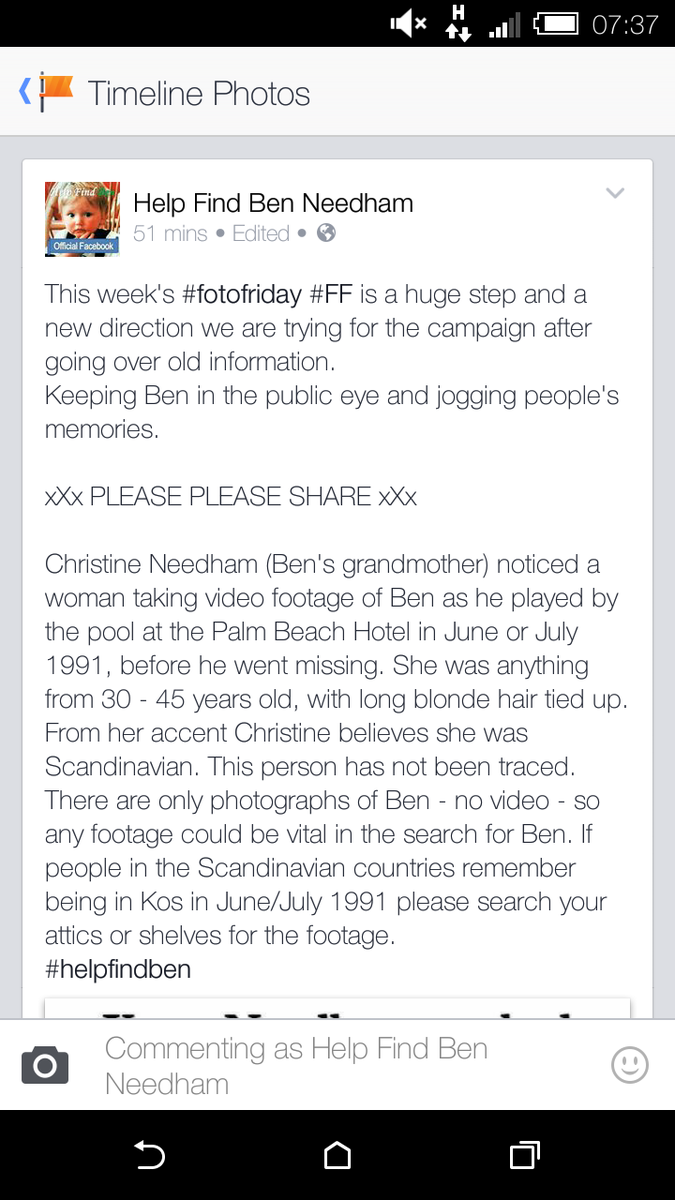
On the morning of Wednesday, July 24, 1991, Kerry had gone to work at a local hotel (seemingly the Palm Beach Hotel), leaving Ben in the care of his grandparents and Stephen. Christine brought Ben (21 months old and a fair-haired, blue-eyed toddler) to the farmhouse in his pushchair to visit Eddie, who was working on the renovation.
The farmhouse sat in a remote, isolated part of the island, accessible by a narrow single-lane track. As the adults worked and rested inside, Ben played happily outside the building, as toddlers do . . . exploring the dirt, the tools, the textures of a world still new to him. At some point during the afternoon, no one is entirely certain when, the adults went inside for lunch. It was not until around 2:30 in the afternoon that his grandparents realized Ben was missing.
There was no immediate alarm at first. The family assumed he had simply wandered out of view, or that Stephen, who had visited the farmhouse on his moped earlier in the day, had taken him somewhere. But when Stephen was reached and confirmed he did not have Ben, the search began in earnest.
The family scoured the area around the farmhouse and the nearby community but found nothing. Greek police from the Kos station were notified, though this took several hours.
Officers arrived that evening, and (as is common in the early stages of any child disappearance investigation) initially questioned the Needham family themselves as potential suspects. This focus on the family caused a critical delay in alerting the island’s airports and harbor. Any window for intercepting someone leaving with a child had narrowed considerably by the time those notifications were issued.
The Police did suggest checking vehicles leaving the island by ferry to Athens and arrangements were made to meet police at the docks at 3:00 am, but no officers appeared.
Over the following eleven days, an extensive search of the island was conducted. Greek police, the Hellenic Army, and fire brigade personnel all participated, combing the rugged terrain around Iraklis. The island’s chief of police at the time, Nikolaos Dakouras, ultimately declared: “We now believe we have searched every possible part of that area, and the boy is not there. It leaves us with a great mystery. We have no theories. We have no solutions.”
No trace of Ben Needham was found. Not a shoe, not a piece of clothing, not a single physical clue.
The case immediately attracted heavy media attention back in the United Kingdom. UK tabloids arrived at the family’s door within hours of the incident, and coverage became a fixture in British news throughout the early 1990s. The story had all the hallmarks of a headline that wouldn’t let go: a young, photogenic blond toddler, a foreign country, a family in crisis, and no answers.
In January 1993, following a direct request from UK Prime Minister John Major to the Greek government, the Hellenic Army undertook a second round of searches on the island. Again, nothing was found.
From very early on, the Needham family believed that Ben had been abducted. The idea that someone had grabbed the toddler from outside the farmhouse, either to sell him into an illegal adoption arrangement or as part of child trafficking, became the family’s primary conviction.
It is worth noting that in 1991, public awareness of child trafficking was almost nonexistent among ordinary families. As Kerry herself later reflected: “We didn’t have any money for a ransom, which is what we thought a kidnapping was. We knew nothing about child trafficking and human trafficking back then, so it just didn’t enter our heads.” It was only gradually, as the years passed and tips trickled in, that the trafficking theory took shape in the family’s understanding of what might have happened.
The case invited comparisons to the later disappearance of Madeleine McCann in Portugal in 2007. . . another British toddler, another southern European holiday setting, another mother left in agonising uncertainty. When the McCann case broke, Kerry Needham came forward publicly to describe the painful recognition she felt watching another family live through what she had endured sixteen years earlier.
Despite the lack of physical evidence, reported sightings of a boy matching Ben’s description flooded in. More than 300 in total over the years, concentrated heavily in the period immediately following the disappearance during 1991 and 1992. Most were in Greece, on the mainland and on various islands.
A witness on the evening of July 24 itself reportedly saw a small blond boy with an older child at a shop counter near the area in what was possibly the first sighting report, logged on the very day of the disappearance.
The following day (July 25), builders working nearby gave statements reporting they say a white vehicle (possibly a Suzuki Alto or similar model) parked in the lane around the time of the disappearance. Inside the car were three people, a woman in the back and two men in the front. In 2000, police stated that the vehicle belonged to a local shopkeeper, Xanthippi (Sissy) Aggrelli, but she denied this stating she had previously scrapped it. Records however showed that she still had the vehicle in November 1991, but the family’s request for further information apparently did not turn up new information.
On July 26, police notified the airport of the disappearance and a kiosk worker came forward to say they had seen a child matching Ben’s description that day; however, this child was never located. The British Embassy was contacted, but allegedly failed to provide assistance, claiming the local police were better equipped and more informed about the case.
In September 1992, South Yorkshire Police used E-FIT software to produce an age-progressed image of what Ben might look like at three years old, reportedly one of the first times E-FIT technology had been used to age a child’s appearance. Further age progression images were released in 2000, 2003, 2007, and 2016.
In December 1995, a private investigator named Stratos Bakirtzis located a blond boy of approximately six years old living with a Romani family in a camp near Salonika (Thessaloniki), Greece. The child reportedly told someone he had been “given to the gypsies because his parents did not want him.” The story generated significant media coverage and raised hopes. Police took the boy into custody and investigated, but determined he was not Ben Needham. His birth certificate was authentic, and it was established that his biological father was in prison, having left the boy in the Romani couple’s care.
In November 1998, a British man named John Cookson, holidaying on the island of Rhodes, noticed a fair-haired child in a group of dark-haired Greek children playing on a beach. Suspicious, he tousled the boy’s hair and managed to collect a hair sample, which he submitted for DNA analysis. The results ruled out any connection to Ben, and the Greek child’s family provided infant photographs as additional confirmation.
In 2003, a private investigator named Ian Crosby built and launched the first dedicated website for the Ben Needham case. He coordinated with the family, traveled to Kos with Ben’s uncle Danny, and met with local Greek police. A photograph sent to Crosby by a holidaymaker who had visited Turkey in 1999 showed a blond child among Turkish village children, a child who resembled the age-progression images of Ben at thirteen. It led nowhere conclusively.
A man came forward in May 2015 claiming to be Ben following a television appeal in Greece, then was proven to be an impostor. As recently as 2023, Kerry Needham has spoken about DNA testing conducted on men who contacted her believing they could be her son. . . each time the results came back negative. “He had absolutely convinced himself that he was Ben,” she said of one such contact. “After speaking with the guy over a matter of weeks I started to convince myself that he was Ben and I’ve been through this many, many times.”
In November 2024, anonymous emails claimed a sighting of Ben in New York in 1991–1992, providing names and details linked to a person of interest on Kos that day. The information was forwarded to South Yorkshire Police; DI Matt Bolger requested enquiries via the Foreign Office. A US specialist missing persons unit interviewed the sender in February 2025. As of late 2025, the family was still awaiting a full update despite repeated requests. Appeals for information continue via the family’s official channels.
In October 2012 (more than twenty years after Ben’s disappearance), South Yorkshire Police travelled to Kos following a new line of inquiry. The theory, which had emerged from investigative work, suggested that Ben had not been abducted at all, but had died accidentally and been buried in building rubble near the farmhouse on the day he vanished.
On October 19, 2012, a joint operation involving Greek police, South Yorkshire Police search advisors, forensic archaeologists, human remains detection dogs, and geophysical survey equipment began examining the grounds around the property where Ben was last seen. The operation was specifically investigating whether an excavator driver clearing land behind the farmhouse that same afternoon in 1991 had accidentally caused Ben’s death and concealed the body in the rubble. The search came up empty; no human remains, no personal effects.
The investigation deepened. In September 2016, police informed Kerry Needham that a man from Kos had come forward following a Greek television appeal in May 2015. That individual claimed that Konstantinos Barkas, a digger operator who had been working at the site near the Needham farmhouse on 24 July 1991, had told him, in confidence, that Ben had died in an accident and that Barkas had hidden the body in building waste. Barkas himself had died of stomach cancer in 2015, months before his name emerged.
Beginning September 16, 2016, South Yorkshire Police began a new round of excavations on Kos, in a slightly different area than the 2012 search. The operation was extensive: over 800 tonnes of soil were dug up over the course of a month, with items of interest shipped back to the UK for forensic analysis. While no human remains were found, investigators recovered a small yellow Dinky toy car identified by the Needham family as belonging to Ben, as well as what appeared to be a fragment of a sandal.
In October 2016, Detective Inspector Jon Cousins, the lead investigator, delivered South Yorkshire Police’s formal conclusion: “It is my professional belief that Ben Needham died as a result of an accident near to the farmhouse in Iraklis where he was last seen playing. The recovery of this item, and its location, further adds to my belief that material was removed from the farmhouse on or shortly after the day that Ben disappeared.”
In July 2017, the force announced that a forensic soil scientist had found a genetic profile consistent with decomposed human blood on the sandal fragment, and that DNA extraction would be attempted. In November 2018, however, police confirmed that the blood found on the toy car was not a match for Ben Needham.
The identification of Konstantinos Barkas as the central figure in the police theory caused immediate and significant distress to his family. His widow, Varvara Barkas, strongly denied the allegations against her deceased husband. His son, Valantis Barkas, gave interviews to Greek media pushing back forcefully against the suggestion that his father had killed the child and concealed his body.
“My father would never do that, he was an honest man,” Valantis said, noting that his father had always believed Ben was abducted and would never have covered up such a crime. He added that his family had received threats following the public identification of his father’s name. He also stated that the South Yorkshire Police officer in charge of the Kos investigation had privately apologized to him for the distress caused to the family, a claim South Yorkshire Police did not publicly contradict, while DI Cousins maintained the force’s stated position. “Based on those facts and the information I have to date,” Cousins said in January 2017, “it is still my professional belief that Ben died as a result of a tragic incident at the farmhouse involving heavy machinery.”
Critics of the digger theory have pointed to at least one significant logistical complication: according to some accounts, Ben had already been missing for approximately two to two-and-a-half hours before Barkas and his digger arrived at the site that afternoon. If accurate, this timing would complicate (though not entirely eliminate) the police’s theory. South Yorkshire Police has not publicly addressed this timing discrepancy in detail.
Through all of it . . . the sightings, the DNA tests, the excavations, the imposters, the police conclusions . . . Kerry Needham has remained an unwavering and very public advocate for her son’s case. She has given countless media interviews, made television appeals in both the UK and Greece, written about her experience, and maintained a social media presence dedicated to finding Ben or, at minimum, finding the truth.
She has been explicit that she does not accept South Yorkshire Police’s 2016 conclusion as the end of the matter. “In our minds Ben is still a missing person,” she told ITV News in 2023. “Even though South Yorkshire Police came to their conclusion in 2016, we as a family have still not got any evidence to say that’s what happened.”
She has also directed appeals at people in their mid-thirties who may have doubts about their own origins, asking anyone who lacks early childhood photographs, who believes they or their own child looks like the age progressed or infant photos, or who has reason to question their family history, to come forward.
“There are some people on Kos that definitely know what happened to Ben,” she has said, “and I don’t know how they can sleep at night knowing the torment I go through year after year. I will never give up searching for the truth even if it kills me.”
Multiple Victims?: No
*If the date says January 1, this is often just a placeholder for an unknown specific date. It usually means “sometime that year”.
🪦Recovery
Date the Body was Recovered:
Description: Unknown
Time of Death:
Cause of Death:
Recovered Remains (if partial):
Suspected Homicide?:
Multiple Victims?: No
DNA Tested (No Match):
*If the date says January 1, this is often just a placeholder for an unknown specific date. It usually means “sometime that year”.
🚗 Vehicle
Description:
License Plate:
🧑🤝🧑 Key Person(s)
Description:
Location
Address: Grandparent's Farmhouse
City: Makris (Μακρης), Kos (Κω)
Province or State: Dodecanese Islands, South Aegean
Country: Greece
Postal Code: 853 09
Latitude, Longitude: 36.8750624,27.3203676
General Location: Town or City
More Details
Related Cases:
Map of Key Specific Locations:
N/A
Photos


*Note that there are mis-translations on the official poster. His hair is Blonde, not Brown. His age was 21 months, not 21 years.
Additional Resources
🎥Videos:
📻Podcasts:
- N/A
Contact Police
🏢 Agency: Hellenic Police (Ελληνική Αστυνομία)
💻 Website: https://www.astynomia.gr
✉️ Email Address: kepik@astynomia.gr
📞 Phone Number (#): 214 6879597
⚠️ Emergency Phone Number (#): 1017
IDD Prefix: 00
Country Code: 30
🔗 Alternative Contact(s):
FOLLOW & SUBSCRIBE
⚠️ Disclaimer & Warning: This case file contains sensitive details or images regarding missing persons and unsolved cases that some readers may find upsetting. All persons read these case files at your own discretion. Information is sourced from NGOs, news articles, blogs, and other alternative media and is general information only. We make no warranties regarding accuracy, validity, availability, or completeness of the data herein. Under no circumstances will The Suitcase Detective or Never Quit Looking be liable for issues resulting from use of this information. Continued use of our Services serves as evidence that you approve our Privacy Policies and Terms & Conditions. If using content from this page, please include a direct link as a source. This ensures readers have access to updates to the information.
Please do NOT copy and paste text from our blog articles. We request that readers be directed to our site instead. This allows us to ensure out-of-date information is not being shared and that readers can access the reference list. If you would like to share a story, you can either use the social media buttons or share a link to this page. The images you are welcome to share.